Bronze Windows: What "Bronze" Means on a Specification

An architect specifies bronze windows. Three suppliers quote. All three quotes say bronze. One is solid extruded architectural bronze, one is aluminum with a bronze anodized finish, and one is aluminum with a bronze powder coat. The price spread between them is enormous, and so is the difference in what the client will be looking at in thirty years.
This confusion is not the architect's fault. The word bronze does double duty in the fenestration industry, describing both a copper alloy and a color. Manufacturers rarely volunteer the distinction, and specification language often does not force it. The result is a specification that appears settled and a product decision that is not.
For window packages specifically, the stakes are higher than they are for doors. Windows involve more units, more operable hardware, more perimeter linear footage, and more exposure. A material decision that is ambiguous at the specification stage compounds across an entire elevation.
This guide covers what actually distinguishes the four products sold as bronze windows, what changes when bronze moves from a door leaf to an operable window, and what to write into a specification so the quote you get back is the product you intended.
The four products sold as bronze windows
Solid architectural bronze
The frame is bronze throughout. The profile is extruded from architectural bronze, a copper alloy, and the material at the surface is the same material at the core. There is no coating, no substrate, and nothing to fail because there is nothing applied.
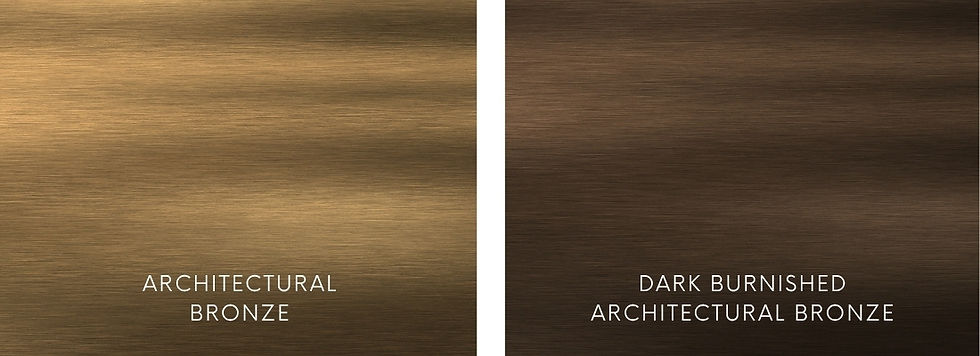
This is the product that lasts. It is also the product that changes appearance over time, because the surface oxidizes and develops the patina that gives bronze its character.
Lucent supplies solid bronze windows through OTTOSTUMM | MOGS, whose BronzoFinestra system is built from solid extruded architectural bronze profiles. The full range of bronze door and window systems, including finish options and how patina behaves over time, is covered on our bronze material page.
Bronze anodized aluminum
The frame is aluminum. An electrochemical process builds an oxide layer into the surface of the aluminum and a dye is introduced during that process to produce a bronze tone.
Anodizing is genuinely integral rather than merely applied, which makes it durable and gives it a depth that paint cannot match. It is a legitimate premium finish and it appears on excellent windows. It is not bronze. The frame will behave like aluminum in every structural, thermal, and corrosion respect, and the finish will hold its color rather than developing patina.
Bronze powder coated aluminum
The frame is aluminum. A dry powder is electrostatically applied and cured to produce a bronze-toned coating.
Powder coating offers the widest color range and the lowest cost of the three metal options, and modern powder coats are durable. But it is a coating on a substrate, and coatings have a service life. Chalking, fade, and chip damage are all possible over decades, and repair means refinishing rather than letting the material be itself.
Bronze clad
The frame core is one material, commonly aluminum or steel, with a thin bronze skin applied to the exterior face. This gives the visible appearance and weathering behavior of bronze at lower material cost than solid extrusion.
Bronze clad is a reasonable product and it is honestly described when suppliers describe it honestly. The specification concern is joint detailing and the long-term behavior of the interface between the cladding and the core, particularly at corners and where operable hardware penetrates.
How to tell which one you are being quoted
Four questions settle it, and any competent supplier will answer all four without hesitation.
What is the frame material, not the finish? If the answer is a finish name rather than a material name, ask again.
Is the bronze extruded or applied? Solid bronze windows are extruded from bronze. Everything else is applied to something.
What is the profile wall thickness, and in what material? Solid architectural bronze profiles run to meaningful thickness in the bronze itself. A specification that quotes a coating thickness in microns is describing a finish.
Will the appearance change over time, and on what timeline? Solid bronze will. Anodized and powder coated aluminum will not, by design. If a supplier promises both bronze character and permanent color stability, one of those claims is wrong.
Pro tip: Ask for the answers in writing on the quote itself rather than in conversation. A supplier who describes the product accurately by email will describe it accurately to your client. A supplier who will only discuss it verbally is telling you something.
Sitting on three quotes that all say bronze? Send them to us. Lucent was founded by an installer, which means we read quotes the way the field reads them, and we will tell you what each one is actually offering even if none of them are ours. Get in touch with us.

What changes when bronze moves from a door to a window
Most published bronze content is written about doors. Doors are the glamour application, and the entry door is where clients notice the material. But window packages carry most of the bronze on a typical project, and they raise engineering questions that door content does not answer.
Operable hardware carries different loads
A door leaf hangs and swings. An operable window sash compresses into a frame, and the hardware that drives that compression works against different forces.
Casement windows swing outward on side hinges and seal by compression when closed, which means wind pressure improves the seal rather than defeating it. That behavior makes casements a strong pairing with bronze, because the material's stiffness holds the compression geometry over long service life.
Tilt and turn units add a second operating mode and a correspondingly more complex hardware set. The frame material has to hold hardware alignment through two distinct motions, which places a premium on dimensional stability.
Awning and hopper units are simpler mechanically but concentrate load at fewer points.
OTTOSTUMM | MOGS supports side-hung, top-hung, bottom-hung, tilt-and-turn, pivoting, sliding, and folding configurations within a single profile family, which is what allows a mixed-configuration elevation to read as one system rather than several.
Sightlines behave differently in fixed and operable units
A fixed unit needs frame enough to hold glass and transfer load to the structure. An operable unit needs all of that plus a sash, plus hardware, plus the gasket geometry that seals the two together.
The practical consequence is that fixed and operable units in the same elevation will not naturally match unless the system is engineered for it. This is a specification question, not a fabrication one, and it needs answering during design development rather than at shop drawings.
Bronze helps here. Because architectural bronze can be extruded into slender sections without losing structural integrity, the gap between fixed and operable sightlines can be closed more tightly than in materials that require bulk to achieve the same strength.
Thermal performance requires a thermal break
Bronze is a copper alloy and copper conducts heat well. A solid bronze frame without a thermal break will behave in a cold climate the way a solid aluminum frame does: cold interior surfaces, condensation at the frame, and measurable heat loss.
Modern bronze systems address this the same way aluminum systems do, with an insulating barrier built into the profile that separates interior and exterior sections. For the mechanics of how that barrier works and why frame conductance matters more in buildings with large glazed areas, see our guide to thermal break windows.
The specification implication is direct: do not assume a bronze window is thermally broken because it is expensive. Ask, and get the frame U-value in writing.
Did you know? Bronze and aluminum are close enough in thermal conductivity that the presence of a thermal break matters far more than the choice between the two metals. A thermally broken aluminum frame will outperform a solid bronze frame without one, every time, in every climate.
Where each product actually belongs

Solid architectural bronze belongs where the material is the point. Heritage and restoration work where period-correct fenestration matters. Coastal and marine exposure where corrosion resistance earns its cost. Projects with long ownership horizons where a hundred-year service life is a real consideration rather than a talking point. Signature elevations where the client is buying the material, not the color.
Bronze anodized aluminum belongs where the bronze appearance is wanted but permanent color stability is preferred, where budget rules out solid bronze across a large unit count, or where the frame needs to match aluminum systems elsewhere on the building. This is often the honest right answer, and specifying it deliberately is better than specifying bronze and receiving it by accident.
Bronze powder coat belongs where color flexibility matters more than material authenticity, where the specification needs to hit an exact custom color, or where budget is the governing constraint. It is the least expensive route to the appearance and there is no shame in choosing it on purpose.
Bronze clad belongs where solid bronze appearance is required on the exterior face but the budget or structural requirement points to a different core.
If your project is heading toward aluminum for structural or budget reasons, our guide to aluminum windows for luxury homes covers finish options and performance in detail, and the engineering behind extruded aluminum window framing explains why profile geometry matters as much as material choice.
For a warmer interior with metal exterior protection, wood-clad hybrid construction is a different route to a similar goal.
What to write into the specification
Ambiguity in the specification is what produces the three-quote problem. This language closes it.
Name the material, not the appearance. "Solid extruded architectural bronze" leaves no room. "Bronze" does.
State the profile thickness in the bronze itself, so a coating specification cannot satisfy the requirement.
Specify the finish condition at delivery. Natural for on-site aging, or factory-applied burnishing to a named color. Both are legitimate. Silence is not.
State the patina expectation in writing, including the fact that appearance will change and roughly on what timeline given the site exposure. This protects everyone. Clients who were told the material evolves accept the first-year color shift. Clients who were not told call it a defect.
Require the frame U-value, not just the whole-window U-value, so thermal break performance is visible rather than averaged into the glazing.
Specify hardware finish separately. Bronze hardware on a bronze frame will burnish at contact points and diverge from the frame over time. Whether that is a feature or a problem is a design decision, and it should be a decision rather than a surprise.
Confirm the configuration range within one profile family if the elevation mixes fixed, casement, tilt-turn, or sliding units.
For a wider view of how bronze sits against the other frame materials available, our door and window materials guide compares the full range, and the block frame window detail guide covers the installation method that conceals the frame within the wall entirely.
Common questions about bronze windows
Is bronze anodized aluminum the same as a bronze window?
No. Bronze anodized aluminum is an aluminum window with a bronze-toned integral finish. The frame is aluminum and behaves like aluminum structurally, thermally, and in corrosion. It is a good product and a legitimate premium finish, but it is a different material from solid architectural bronze and will not develop patina.
How do I tell what a supplier is quoting?
Ask what the frame material is rather than what the finish is, and ask whether the bronze is extruded or applied. Solid bronze windows are extruded from bronze. If the answer describes a coating thickness or a finish process, you are being quoted aluminum with a bronze appearance.
Do bronze windows need a thermal break?
Yes, in any climate with meaningful winter temperatures. Bronze is a copper alloy and conducts heat readily. Without an insulating barrier separating interior and exterior frame sections, a solid bronze frame will run cold on the interior surface and produce condensation. Modern bronze systems incorporate thermal breaks as standard, but confirm it rather than assuming.
Can bronze windows match a mixed elevation of fixed and operable units?
Yes, if the system is engineered for it. Fixed units and operable units have different structural requirements, so their sightlines will not match by default. Specify that fixed and operable profiles must present matching exterior sightlines, and confirm the manufacturer offers the full configuration range within one profile family.
Are bronze windows worth the cost over bronze anodized aluminum?
It depends entirely on what the project is buying. If the client wants a material that lasts a century and evolves in appearance, solid bronze is the only product that delivers it. If the client wants a bronze appearance with stable color and lower cost, anodized aluminum delivers that better than solid bronze does. Neither answer is wrong. Specifying one and receiving the other is.
Will bronze windows look different from bronze doors on the same project?
Potentially, and it is worth planning for. Doors receive daily handling, which burnishes contact areas and keeps them brighter than surrounding surfaces. Windows do not. On a project with both, the entry doors will develop a different character from the window package over time. Some architects design for that contrast deliberately.
What happens to bronze windows in coastal environments?
Bronze performs exceptionally in marine exposure, which is one of its strongest arguments. It does not corrode in salt air the way steel does, and the patina that forms actually protects the surface. Salt air does accelerate the patina timeline noticeably, so the color shift arrives faster than it would inland. Set that expectation with the client during design.
Specifying bronze windows on your next project
The word bronze covers four different products, and the difference between them determines what the building looks like in three decades. Solid architectural bronze is the only one of the four that is actually bronze, and it is the right answer for a specific set of projects rather than all of them.
The failure mode is not choosing wrong. It is not choosing at all, and letting the ambiguity in a specification resolve itself at the quote stage.
Lucent was founded by an installer rather than a salesperson, which shapes how we answer this question. We carry solid bronze through OTTOSTUMM | MOGS and we carry aluminum systems that do a bronze appearance extremely well, so the recommendation is not a function of what we happen to stock. Sometimes the honest answer is that a project should not be buying solid bronze.
Contact the Lucent team to talk through configurations, finish strategy, and what belongs in the specification before it goes out to bid.