Block Frame Window Detail: The Installation Method That Makes Clean Lines Possible

A block frame window detail is the architectural solution that allows a window frame to disappear entirely behind interior finishes and exterior cladding, leaving only glass visible. It's not a window product. It's an installation method, and specifying it correctly is the difference between a clean, frameless-looking result and a window that will always show its edges. If floor-to-ceiling glass and razor-thin sight lines are on the drawing set, the block frame is how you get there.
Most windows installed in American residential construction use a nail flange method: a pressed-on flange that gets taped to the sheathing before siding goes over it. It works for standard builds. But it locks the window into a fixed position in the wall, limits your detailing options, and creates a siding-to-window butt joint that will eventually fail. Block frame installation eliminates all of that. The window is screwed directly through the jambs into framing, sealed front and back, and the cladding runs right over it. The frame is there, but it's buried.
What Is a Block Frame Window Detail?
A block frame window (also called a European-style or unflanged window) has no nail fin around its perimeter. Instead of being attached through a flange to the wall sheathing, it's secured by screwing directly through the jamb and head into the rough opening framing. The window sits inside the wall assembly, and both interior finishes and exterior cladding are designed to cover it completely.
The block frame detail originated in European construction, where walls are predominantly concrete or masonry, sometimes 18 inches thick, and a nail flange would be impractical. In that context, setting the window at any depth within the wall assembly and capping it with finished surfaces on both sides is standard practice. American wood-frame construction adopted the method more slowly, but it's now the preferred approach for high-performance and design-forward builds.
Pro tip: A standard 2x6 wall assembly runs roughly 6.5 to 7.5 inches deep depending on cladding. A 4-inch block frame window can be positioned at any point within that depth, giving you full control over the reveal on both sides.
How Does Block Frame Installation Work?

The Basic Process
The installation process is straightforward once the rough opening is prepared and the window is on site:
Set the window into the rough opening from the interior or exterior, depending on site conditions and window weight.
Shim to level and plumb, confirming the window is square before fastening.
Screw through the jambs and head directly into the framing. No flange, no straps required.
Apply backer rod and caulk at the exterior sheathing line. This is your bulk water management layer.
Fur out the interior wall so drywall returns and jamb liners finish flush to the inside face of the window frame.
Run siding or cladding over and past the window frame on the exterior, overlapping the frame entirely.
Apply interior air seal caulk at the interior frame-to-drywall junction.
The result on the exterior: cladding covers the frame completely. The result on the interior: drywall returns flush to the glass. The window frame is installed, functional, and entirely hidden.
The Two-Seal Approach
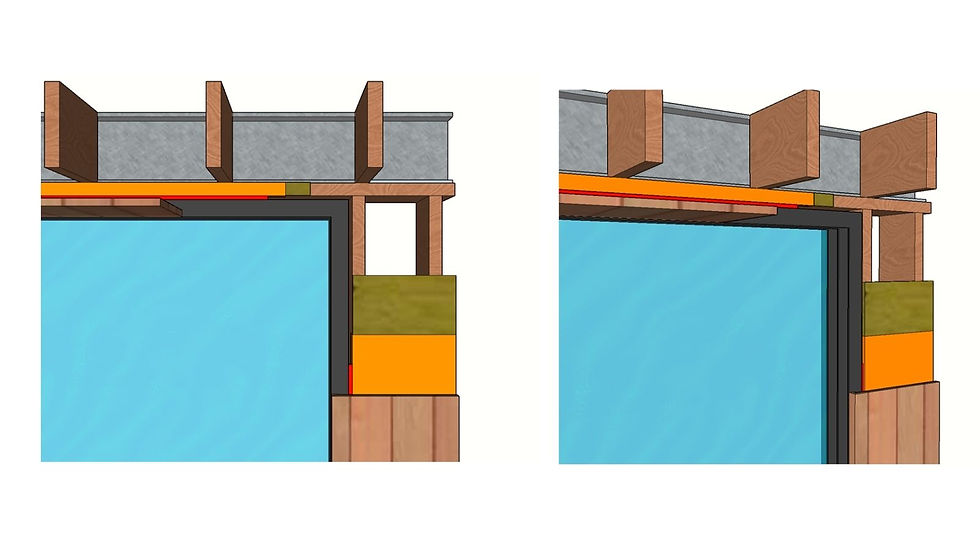
One of the performance advantages of the block frame detail is how water management is handled. Rather than relying on a single flange-and-tape seal, the method uses two distinct lines of defense. The exterior caulk at the sheathing manages bulk water. Rain hitting the wall sheds off the cladding and never reaches the window-to-sheathing junction. The interior caulk provides the air seal. Because siding caps over the window rather than butting up to it, there's no exposed siding-to-frame joint to fail over time.
According to the Building Science Corporation, two-stage sealing systems that separate bulk water management from air sealing consistently outperform single-layer approaches in long-term water infiltration testing.
Did you know? With most block frame windows, glass and frame are separate components. If a pane needs to be replaced, a glazier can remove a few perimeter caps, swap the glass, and reinstall without touching the frame or the wall. No demolition required.
Block Frame Window vs. Nail Flange: Why It Matters for Design

What's Wrong with the Nail Flange Method?
Nail flange windows, which are what most American manufacturers produce as their standard new construction windows, work fine in conventional builds. The flange extends off the side of the frame, gets nailed or screwed through to the sheathing, and is taped with adhesive membrane before siding goes on. For a builder running tract housing, it's fast and familiar.
The problem is what it prevents you from doing.
The flange location is fixed. The "nose," meaning the portion of the frame that projects past the flange to the exterior, is typically about one inch. On a standard wall with half-inch sheathing and standard siding, that works. Add an inch of exterior rigid insulation plus furring strips plus siding and your wall buildup is now thicker than your window projection. The detailing becomes complicated, the flashing gets ugly, and there's no clean solution.
The deeper problem: the flange and tape get buried under siding. When a nail flange window needs to be replaced, the siding comes off first. It's a demolition project regardless of the condition of the surrounding wall.
Why Block Frame Installation Is the Better Choice for High-End Builds

Block frame installation doesn't have a fixed setback. You choose where the window sits in the wall based on the interior and exterior details you want to achieve. That flexibility matters enormously when you're working with deep wall assemblies, exterior insulation, or custom cladding profiles.
It also matters for longevity. The block frame window can be accessed and replaced without disturbing the cladding. The siding isn't bonded to the installation method. It just runs past the window. Future service doesn't require future demolition.
For projects where the window is meant to disappear, there's no version of the nail flange detail that achieves a fully buried frame. The geometry doesn't allow it.
Pro tip: When specifying a block frame window for a buried frame detail, confirm with the manufacturer that the frame depth is narrow enough to be fully concealed within the wall assembly. Not all block frame profiles are the same depth, and a frame that's too wide will project past your finished surfaces.
Frame depth and profile precision begin at the extrusion. Our extruded aluminum window framing guide covers how those profiles are engineered for minimal sight lines.
New Construction Windows vs. Replacement Windows: Which Uses Block Frame?

New Construction Windows
New construction windows are designed to be installed when wall framing and sheathing are exposed, before cladding goes on. They're typically supplied with a nail flange as standard. However, manufacturers who serve the architectural market also offer new construction windows in a block frame profile, specifically for projects where the buried frame detail is part of the design intent. When specifying for new construction, request a block frame profile explicitly. Don't assume.
Replacement Windows
Replacement windows, those designed to go into an existing opening without removing the old window frame, are almost always block frame by necessity. The existing frame stays in place. The old window sashes and stops are removed, the new window is inserted into the opening, secured through the jambs, and sealed. There's no exposed sheathing to attach a flange to.
This is worth understanding because it means block frame installation is actually the more widely used method across the industry. Most people just encounter it in a replacement context rather than a design-forward new construction context. The buried frame detail repurposes the same basic approach for a completely different architectural outcome.
Lucent's door and window systems are engineered specifically for the kind of precision detailing that block frame installation requires. If you're working through glazing options for a current project, explore the full systems lineup here.
What to Specify for a Buried Block Frame Window Detail

Getting the buried frame detail right requires coordination across the wall assembly, not just the window spec. Here's what needs to be locked in before the window is ordered:
Window system: Block frame profile, no nail flange. Confirm in writing with the manufacturer.
Frame depth vs. wall depth: The frame must be narrow enough to be fully concealed within the finished wall assembly on both sides.
Interior fur-out dimensions: Drywall returns need to be furred to the correct depth so they land flush with the interior face of the frame, not proud of it and not recessed from it.
Exterior cladding overlap: Siding or cladding needs to be detailed to run past the window frame, not butt up to it.
Sealant spec: Specify a two-stage seal. Exterior backer rod and caulk for bulk water, interior caulk for air sealing.
Serviceability: Confirm that glass replacement is possible without frame removal. This should be standard on quality block frame systems, but verify it.

For projects involving large sliding glass panels alongside buried window frames, the detailing principles carry across. This sliding systems comparison guide covers how to approach the transition between operable and fixed glazing in the same wall plane.
Frequently Asked Questions About Block Frame Window Details
What is a block frame window detail?
A block frame window detail is an installation method in which the window frame is screwed directly into the rough opening framing with no nail flange, then covered on both sides by interior finishes and exterior cladding. The result is a window where only the glass is visible. The frame is fully concealed within the wall assembly.
How is a block frame window different from a standard nail flange window?
A nail flange window has a pressed-on flange that extends off the frame perimeter and is fastened to the wall sheathing before siding is applied. A block frame window has no flange. It's secured through the jambs directly into framing and can be positioned at any depth within the wall assembly. The block frame method allows the frame to be buried behind finishes; the nail flange method does not.
Can block frame windows be used in new construction?
Yes. While block frame windows are commonly associated with replacement window projects, they're equally appropriate, and often preferable, for new construction where the design calls for a buried frame detail, deep wall assemblies, or exterior insulation. The key is specifying the block frame profile explicitly with the manufacturer, since nail flange is typically the default for new construction windows.
Are block frame windows harder to waterproof than flanged windows?
Not when the detail is executed correctly. Block frame installation uses a two-stage sealing approach: exterior caulk at the sheathing for bulk water management, interior caulk for air sealing. Because cladding runs past and over the window frame rather than butting up to it, there's no exposed siding-to-frame joint, which is actually one of the most common failure points in nail flange installations.
Can a block frame window be replaced without removing the siding?
Yes, and this is one of the significant long-term advantages of the method. Because the frame is independent of the cladding, the window can be accessed and removed from the interior without disturbing the exterior finish. Nail flange windows, by contrast, require siding removal to access the flange before replacement can begin.
What wall assemblies work best with a block frame window detail?
Block frame installation works with standard 2x4 and 2x6 wood frame construction, and it's particularly well-suited to deep wall assemblies with exterior rigid insulation. It's also the standard method for masonry and concrete construction. The key variable is matching frame depth to wall assembly depth so the frame can be fully concealed on both sides.
How do I specify a block frame window detail for a project?
Specify the window system as a block frame profile with no nail flange, confirm the frame depth against your wall assembly, detail the interior fur-out so drywall returns flush to the frame face, and specify exterior cladding to overlap the frame rather than butt to it. Sealant should be called out as a two-stage system. Coordinate with your glazing supplier early, as not all manufacturers offer block frame profiles as a standard option. Contact Lucent to discuss project-specific detailing.
The Frame Does Its Job Best When You Can't See It

The buried frame look that defines the best contemporary residential architecture isn't an accident, and it isn't only achievable with exotic European glazing systems. It starts with specifying the right installation method, block frame with no flange, and detailing the wall assembly to finish flush on both sides.
The Seabeck project images throughout this article show what that looks like in practice: during framing, you can see exactly how the frame gets set into the wall. At completion, it's gone. Sill buried under the floor finish. Head buried behind the soffit. Only glass.
That's the block frame window detail working exactly as it should.
For pass-through openings where the same flush detailing principle applies to a different typology, this comparison of pass-through window types is worth a look.
Ready to work through the glazing details on a current project? Connect with the Lucent team here.
Explore Lucent's window systems for the full lineup.